Pages

Saturday, 29 February 2020

De Haan, Belgium

The small town of De Haan lies on the Belgian coast, between Oostende and Blankenberge.  Its population of around 12,000 is swelled during the summer months by holidaymakers drawn to its long, sandy beach.

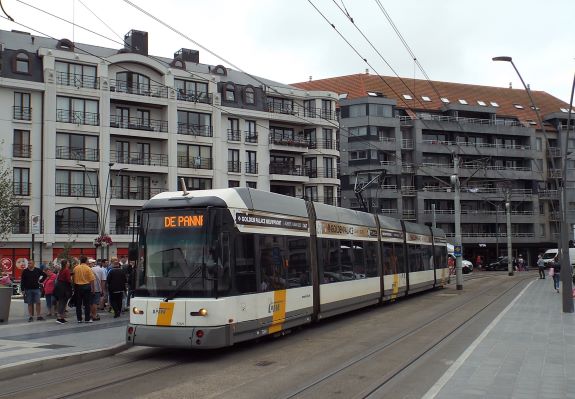
Belgium's coastal tramway is the main public service in De Haan.  The tramway is the world's longest tram route, stretching for around 70 kilometres along the entire coastline of Belgium.  It is operated by De Lijn, which provides local public transport services throughout Belgium's Flanders region.

The tram is around 600 metres inland as it passes through De Haan.


When I visited De Haan in August 2018, I found many of the trams carrying advertising liveries.


De Haan's main tram stop is in the centre of the town.


The original station building now serves as De Haan's tourist information office.

It carries the town's name in French, Le Coq sur Mer, as well as in Flemish.  Le coq means "the hen", as does "de haan" - the town takes its name from a hotel of this name.


Although the station building is no longer used in connecton with the tram, there is a "Lijnwinkel" kiosk on the opposite platform for De Lijn tickets and information.

This may only be open seasonally.


The coastal tram operates seven days a week throughout the year.  The basic frequency is every 15 minutes throughout the day, although on Mondays to Fridays durng the winter months, this is reduced to every 20 minutes.  Late evening services also operate less frequently.

During the summer months, however, the tram frequency is enhanced to every 10 minutes to cater for holiday traffic.  This requires additional trams, which are loaned from the system in Gent for the peak summer season.

The Gent trams appear to be freely mixed with those belonging to the coastal tramway.


Apart from the tram, public transport in De Haan is limited to a couple of bus services, both of which are infrequent.

Bus route 31 heads inland from De Haan to Brugge, better known (at least to visitors from the UK) as Bruges.

This operates six times a day on Mondays to Saturdays, with three journeys a day on Sundays.

I found some journeys on route 31 were operated with articulated buses.


Other journeys were operated with standard single-deck buses.


The other bus route to serve De Haan is route 46.

This is a very limited service running on Mondays to Fridays, comprising a single early morning journey from De Haan to Oostende, then two round trips from Oostende to De Haan in the late afternoon.

It does not reach the centre of De Haan, terminating instead as it reaches the edge of the town.

Buses on route 46 display Klemskerke as their destination, rather than De Haan.

I found a small single-deck bus in use on route 46.


Fares on the De Lijn system are quite simple.  A single-journey ticket costs €3.  This allows interchange for up to 60 minutes after boarding.  However, 10-journey tickets offer a considerable saving, as they can be bought for €16.  Two or more people can travel together using one 10-journey ticket - you simply validate it once per person when first boarding.

A one-day ticket allowing unlimited travel on all DeLijn services throughout the whole of Flanders (apart from one or two express buses in the Brussels region) is available for €7, with a three-day version costing €14.

There is also a seven-day pass allowing unlimited travel in West Flanders province, covering the whole of Belgium's coastline and also stretching inland to include places such as Brugge (Bruges) and Ieper (Ypres).  This costs €26 for one person, or €40 for two people travelling together.

Private coach tours from other places can be seen visiting De Haan.  This image shows a coach from Luxembourg.


Finally, in recent years, cycle hire schemes have become quite widespread.  De Haan doesn't have one.  It does, however, have one or two cycle hire businesses renting bicycles and go-karts.

Friday, 31 January 2020

Blankenberge, Belgium

The town of Blankenberge lies on the coast of Belgium.

As with all settlements on the Belgian coast, Blankenberge is on the route of the Belgian coastal tram.


Running from Knokke-Heist near the Dutch border, through Blankenberge and Oostende to De Panne close to the border with France, linking all the communities along the Belgian coast, the coastal tram route stretches for nearly 70 kilometres. This makes it the longest tram line in the world.

The tram is the principal local transport service in and through Blankenberge.

The tram is operated by DeLijn, who provide local bus and tram services throughout Belgium's Flanders region.

De Lijn's fleet livery is white, grey and black with a yellow flash.  However, a number of the trams carry advertising liveries.


The tram generally operates every 15 minutes, 7 days a week.  From October to March, the frequency drops to every 20 minutes on Mondays to Fridays, although a 15-minute frequency is maintained at weekends.  Trams are less frequent during the early morning and evening.


During the high summer months, however, the Belgian coast is busy with holidaymakers, and the tram frequency is increased to every 10 minutes.

Extra trams are loaned from the system in Gent for July and August to enable this enhanced service to operate.


The tram is complemented by a couple of bus services.

Bus route 33 links Blankenberge with the nearby city of Brugge, also known as Bruges.  Buses generally run at an hourly frequency, seven days a week.

I found articulated buses and standard single-deckers in use on route 33.


Route 38 is a local service operating within Blankenberge, under the brand name "Centrumbus".  I found a minibus in use on this service.


Like route 33, route 38 operates to an hourly frequency, seven days a week, but there is no evening service.


There is one further bus service.  Route 36 is a demand-responsive service operating from Blankenberge into the sparsely-populated area inland.  DeLijn's demand-responsive services are branded as 'Belbus'.

A simple fare system applies on the DeLijn network, including Belbus services.  At the time of writing a single ticket costs €3, regardless of distance travelled, and includes interchanges for up to 60 minutes after first boarding.  10-journey tickets are available for €16, offering a considerable saving over individual single tickets.  A one-day ticket giving unlimited travel on almost all DeLijn services is available for €7, there is also a three-day ticket costing €14.

Single journey tickets and 1- and 3- day tickets can be bought from bus drivers.  They are also sold by tram drivers, at stops which do not have a ticket machine or a ticket vending kiosk.  Ticket vending kiosks and ticket machines at tram stops also sell the 10-journey ticket, these cannot be bought on board a bus or tram.  Belgian railway stations and a network of ticket agents also sell the 10-journey ticket and the 1- and 3-day tickets.

Tickets can also be bought by SMS text message for immediate use, or on a mobile app for immediate or later use.  Tickets bought by SMS or mobile app are considerably cheaper than traditional tickets.

Within the West Flanders province, there is also a 7-day pass valid on all DeLijn services within the province.  West Flanders covers the entire Belgian coastline, and also includes Brugge and Ieper (Ypres).  The 7-day pass costs €26 for one person or €40 for two people travelling together.  Unlike the 1- and 3-day tickets, the 7-day pass is restricted to West Flanders and cannot be used on services in other provinces.  The 7-day ticket is sold by ticket machines and ticket vending kiosks.

Finally, DeLijn is not the only transport provider in Blankenberge.

The town has a railway terminus, with hourly trains to Brugge, Gent, Brussels and beyond.  These are provided by Belgian national rail operator NMBS/SNCB.

The rail system has its own fare and ticketing system, which is separate from the DeLijn system.  DeLijn tickets cannot be used on NMBS/SNCB train services.

Images in this post were taken during August 2018.

Tuesday, 31 December 2019

Saltburn, UK

The small town of Saltburn lies on England's north east coast.  The town developed in the mid-19th Century, both as a seaside resort and also as a centre from which to exploit ironstone which was (and still is) mined nearby.  Today, Saltburn is home to around 6,000 people.

The town itself is perched on cliffs overlooking the beach and the sea.

A funicular railway was built in the 1880s, to improve access between the town and the seafront.  It remains in operation, at weekends from mid-March until October and daily during the peak summer season.

The funicular is powered using water, which is pumped to the upper station then into a tank in the car there, the car then descends by gravity.  The cars are joined by a cable, thus the descending car laden with water pulls the other car up to the top.


More information about the funicular - or the Saltburn Cliff Lift, to give it its proper title, can be found on the Saltburn by the Sea website.

The funicular is not the only railway catering to visitors to Saltburn.  The Saltburn Miniature Railway runs through parkland for about a kilometre from a terminus close to the beach.

The railway operates from around Easter until the end of September.  During school holidays it operates daily except Mondays, otherwise it operates at weekends.

I visited Saltburn out of season, during early March 2019.  Neither the miniature railway nor the funicular were operating when I visited.


Saltburn is served by two regular transport modes, bus and local rail.

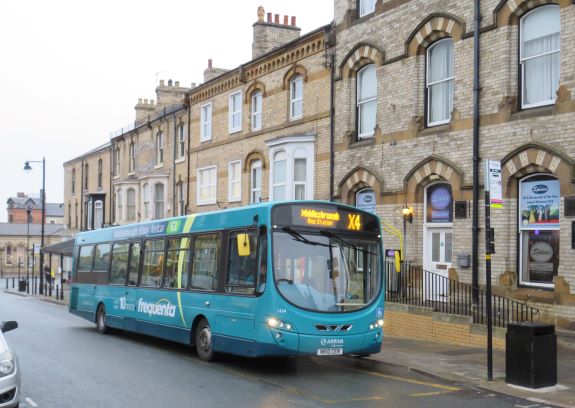
The bus services are provided mainly by Arriva, under their "Sapphire" brand.  Single-deck buses with a single set of doors are operated.

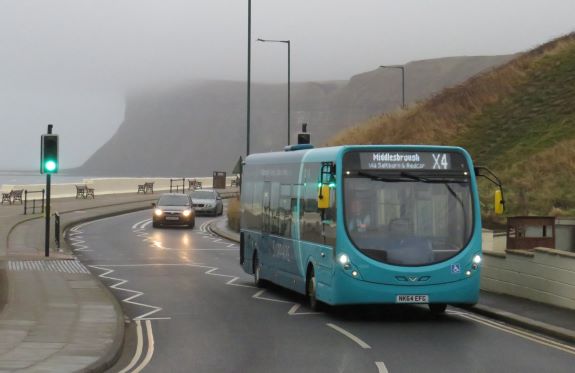
Bus routes X3, X3A and X4 provide a combined 15-minute daytime frequency to Saltburn from Middlesbrough and Redcar.

Routes X3 and X3A each continue hourly beyond Saltburn to nearby Lingdale and Skelton while route X4 operates half-hourly onwards to the town of Whitby, further along the coast.


The route taken by the X4 as it enters and leaves Saltburn to and from Whitby uses Saltburn Bank, with a gradient of 1-in-4 (25%) and hairpin bends.


Route X4 is more than 50 kilometres in length.  This would require it to be operated in accordance with EU Drivers' Hours regulations.  These are more stringent than the rules which apply in the UK to scheduled bus routes of less than 50 km.

There is some kind of legal dispensation under which UK bus services can operate under domestic rules, even if they are more than 50 km in length.  They must be advertised as operating in sections (even if the bus and driver both complete a through journey, with nothing more than a change of destination display).  A number of operators take advantage of this dispensation - I have commented on it previously in posts about other places in the United Kingdom.

So, when passing through on their way to Whitby, buses on route X4 display Loftus (for Whitby) as their destination.  On reaching Loftus, the driver will change the display, then continue the journey to Whitby.


A slightly different pattern of services is operated on Sundays.

Route X4 runs hourly rather than half-hourly.  Routes X3 and X3A don't operate, but a service numbered 3 operates in place of the X3.

However, route 3 runs only as far as Redcar, with just the hourly X4 operating to Middlesbrough on Sundays.


"Sapphire" is one of Arriva's premium brands, with buses advertised as providing high-quality seating and free wi-fi.

During the few days I was in and around Saltburn, I noticed several buses which were not to Sapphire specification operating on routes X3, X3A and X4.


At least two were branded for a different route in the Middlesbrough and Redcar area.


Perhaps it was only to be predicted that while buses branded for route 63 were operating on the X4, at least one of the "Sapphire" buses branded for the X3, X3A and X4 was at work on route 63 in Redcar.


Fares on Arriva's services vary according to distance travelled.  Single and same-day return fares are available.

There is also an array of day tickets allowing unlimited travel, either within a specific area or on Arriva services throughout the north east of England.  In addition, there are day tickets which allow travel on buses operated by other companies, or on certain local rail services.

Arriva's services routes serving Saltburn operate until mid-evening.

During the later evening, Redcar & Cleveland Council provides a minibus service numbered 708 from Saltburn to Lingdale and Loftus.

This service runs six evenings a week.  There is no service on Sundays.


There is one other bus route serving Saltburn.

During the summer months, Moorsbus provides a network of bus routes to enable leisure access by public transport to the North Yorkshire Moors national park.  One Moorsbus journey leaves Saltburn on a Sunday morning, returning in the evening.

The Moorsbus network used to be funded by the North Yorkshire Moors National Park Authority.  However, austerity imposed by the UK government resulted in severe cuts to funding, which meant that the National Park Authority could no longer afford to provide the network.  Moorsbus is now co-ordinated by a team of volunteers relying on donations to keep a reduced network operating.

Finally, Saltburn is the terminus of a local railway line. 

The main station building was sold off some years ago, and has been converted for other commercial uses.  Trains now serve platforms to the side of the building.


Trains generally run half-hourly to Redcar, Middlesbrough and Darlington, where there are main line connections to other parts of the UK.

It may be noted that Arriva's bus services duplicate and compete with the rail service rather than being integrated with it.

This Geograph image copyright to Richard Vince.