The island of Phuket is one of Thailand's major tourist destinations, famed for its beach resorts. It lies around 700 kilometres south of the Thai capital, Bangkok.
The biggest of the beach resorts is Patong Beach, on Phuket's west coast. I spent a few days there in April 2018.
 Public transport in Patong Beach is fairly limited. A half-hourly bus service links the resort with Phuket Town, the main town on the island. Phuket Town is the hub for the island's bus services.
Most of the buses I saw running to and from Phuket Town were these truck-derived vehicles in a blue livery.


These vehicles have an entrance at the back.


 I did see one vehicle which was a more conventional bus, with entrance and exit doors.

The bus service does not have fixed stops, but will stop on request. In Patong Beach, it picks up along the beachfront, on Thawewong Road. Official information about the bus service is more-or-less impossible to find.
 A second service linking Patong Beach with Phuket Town is provided by air-conditioned minibuses.

This service also has little if any publicity. I found it by chance. It appears to operate hourly, picking up passengers outside the Jungceylon shopping centre in Patong Beach.
 In early 2018, Phuket Smart Bus began operation. This introduced a direct bus link between Phuket's airport to the north of the island and the beach resorts along the west coast.
Previously the journey between Patong Beach and the airport, or from Patong Beach to other resorts along the coast, would have involved travelling into Phuket Town then changing buses - or going by taxi.
In early 2018, Phuket Smart Bus began operation. This introduced a direct bus link between Phuket's airport to the north of the island and the beach resorts along the west coast.
Previously the journey between Patong Beach and the airport, or from Patong Beach to other resorts along the coast, would have involved travelling into Phuket Town then changing buses - or going by taxi.
 High-specification minicoaches operate the Phuket Smart Bus route.


 At the time I was in Patong Beach, Phuket Smart Bus was operating to a timetbale with alternating 1-hour and 3-hour intervals. I understand the service has since been increased to hourly.
Fares cannot be paid directly in cash, but must be paid using a Rabbit smart card. However, Rabbit cards are sold on the bus.
The Phuket 101 website gives an overview of Phuket Smart Bus as well as the traditional bus services on Phuket.
 Taxis are plentiful in Patong Beach. I didn't see any of the three-wheel "tuk-tuks" which can be found on the streets of Bangkok, but I did find plenty of these small four-wheel vehicles touting for business.
Fares on these taxis are not metered, tourists are advised to agree the fare with the driver before the journey.
Taxis are plentiful in Patong Beach. I didn't see any of the three-wheel "tuk-tuks" which can be found on the streets of Bangkok, but I did find plenty of these small four-wheel vehicles touting for business.
Fares on these taxis are not metered, tourists are advised to agree the fare with the driver before the journey.


 Although many were painted red, I also saw other colours too - pink, yellow, green and blue.
In this image (right), the sign on the street corner shows the tsunami evacuation route, a reminder of the devastating event which hit Patong Beach - and many other coastal resorts - in 2004.
Although many were painted red, I also saw other colours too - pink, yellow, green and blue.
In this image (right), the sign on the street corner shows the tsunami evacuation route, a reminder of the devastating event which hit Patong Beach - and many other coastal resorts - in 2004.


 There are also metered taxis operating in Patong Beach.


 Unsurprisingly for a major tourist hotspot, private coaches visit Patong Beach.

 Finally, some of the hotels and tourist attractions have their own private transport, as shown by these truck-derived vehicles.

Until this year, all of my travels had been in Europe or North America. That changed in April 2018, with a trip to Thailand.
Bangkok, the Thai capital, is a city of around 8 million people. Like many cities, it faces some serious challenges from road congestion and poor air quality.
Bangkok's public transport system is co-ordinated by Bangkok Mass Transit Authority.
Over the last two decades, five metro lines have been opened in Bangkok. These do not form a single unified system, but operate as three separate metros with almost no through ticketing. The first metro line opened in 1999, the most recent in 2016. Further extensions are under construction.
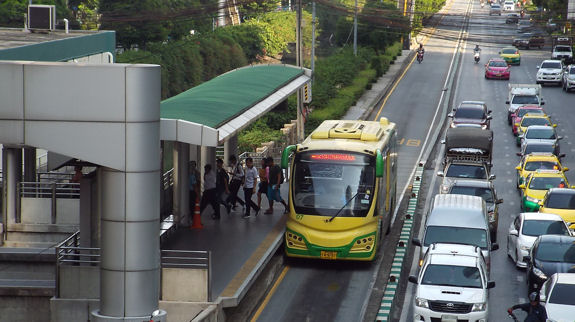
 Complementing the metro systems is a bus rapid transit route. This runs to the south of Bangkok's city centre, connecting at both termini with one of the metro lines.
Surprisingly, the vehicles used on the bus rapid transit service are relatively small and therefore relatively low-capacity.
 All of the bus rapid transit stops are in the centre of the road. The stops have high platforms, providing level access onto the buses. Access to the stops is through ticket barriers.
Thailand drives on the left, but the layout of the stops means that these buses have doors on the right hand side.

 The bus rapid transit service operates along priority lanes - either reserved only for the BRT or shared only with other high-occupancy vehicles.
 Although the doors for boarding and alighting are on the right hand side, the buses also have a set of doors on the left.
 An extensive network of conventional bus services operates on Bangkok's streets. I noted a wide variety of vehicles and colour schemes. There is some meaning to at least some of the colour schemes.
Buses in a red and cream livery offer the cheapest fares, at 6.50 baht per journey irrespective of the distance travelled. A supplement applies on night services and those using the expressway.
An extensive network of conventional bus services operates on Bangkok's streets. I noted a wide variety of vehicles and colour schemes. There is some meaning to at least some of the colour schemes.
Buses in a red and cream livery offer the cheapest fares, at 6.50 baht per journey irrespective of the distance travelled. A supplement applies on night services and those using the expressway.
 All of the red and cream buses that I saw had two sets of entrance and exit doors towards the centre of the vehicle.


 I mentioned above that Bangkok has a problem with its air quality.
Although public transport can help tackle the issue, this vehicle was visibly contributing to the problem!
As well as the red and cream buses, there are also buses in blue and white, and in pink. A higher fare of 7.50 baht is charged on these buses.




 Not all of the buses I saw had the centre entrance/exit door arrangement.
Some had entrances and exits closer to the front and towards the rear.

Very few of the buses had entrance doors at the front.
As far as I could tell, Bangkok's buses had a two-person crew with a conductor taking fares.
 As well as full-size buses, there were also some which were shorter length.
These had open entrances and exits near the front and towards the rear.
Although they were fitted with doors, at both entrances/exits, I found the doors were left open.


 Further variety is provided by buses with air-conditioning. Higher fares are charged on these buses ranging from 11 baht to 24 baht depending on the distance travelled..
Most of the air-conditioned buses had doors at the front and centre.


 Although most of the air-conditioned buses had entrance doors at the front, not all did.
This one had doors only at the centre.
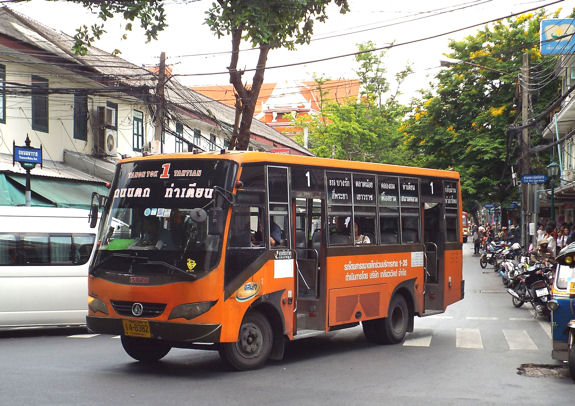
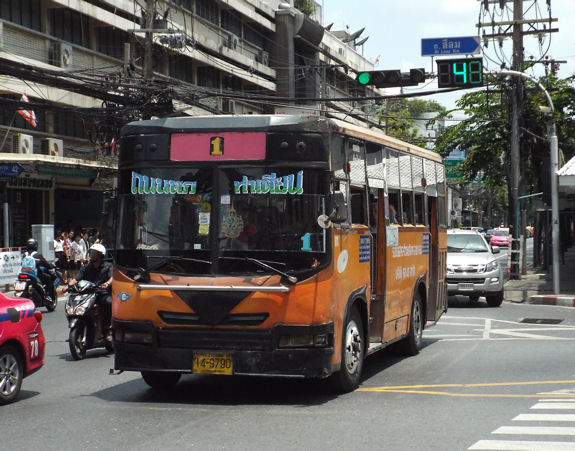
 As well as conventional buses, there are some services operated by small truck-style vehicles.
In the image below, 1271 is the route number, shown above the front windows.

 Tuk-tuk taxis provide "on-demand" transport on the streets of Bangkok.


 Competing for the "on-demand" transport market are conventional taxis.
These proclaim themselves to be "metered taxis", as the fare is governed by an on-board meter. This is in contrast to the tuk-tuks, which are not metered and where the fare is merely a verbal agreement between driver and passenger.


 A public bicycle hire scheme, Pun Pun Bike Share (website only in Thai) has operated in Bangkok since 2012.

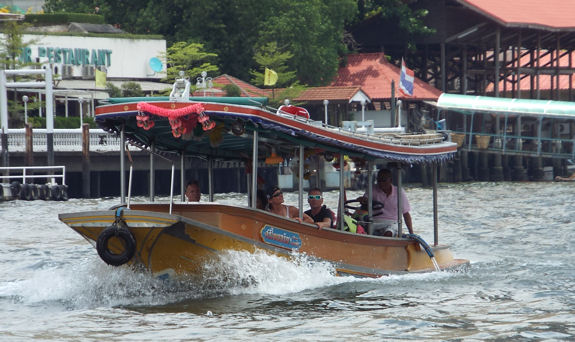
 Bangkok also has an extensive array of waterborne transport, on the Chao Phraya river which flows through the city.
There are ferries across the river, boats which sail up and down the river serving piers along the route, boats for private charter...
Bangkok also has an extensive array of waterborne transport, on the Chao Phraya river which flows through the city.
There are ferries across the river, boats which sail up and down the river serving piers along the route, boats for private charter...
 These photos show some of the variety of craft plying their trade along and across the Chao Phraya.


 Finally, something quirky. The Terminal 21 centre is a large shopping complex. Each of its nine levels is themed on another of the world's major cities. The theme for the second floor is my home city, London.
The theme is represented by, amongst other things, a mock-up of a red Routemaster bus and a London Underground train.
Finally, something quirky. The Terminal 21 centre is a large shopping complex. Each of its nine levels is themed on another of the world's major cities. The theme for the second floor is my home city, London.
The theme is represented by, amongst other things, a mock-up of a red Routemaster bus and a London Underground train.
For further reading, the Train36 website gives a more detailed perspective of Bangkok's bus system while Transit Bangkok gives a good overview of the entire public transport system.
 Public transport in Patong Beach is fairly limited. A half-hourly bus service links the resort with Phuket Town, the main town on the island. Phuket Town is the hub for the island's bus services.


 I did see one vehicle which was a more conventional bus, with entrance and exit doors.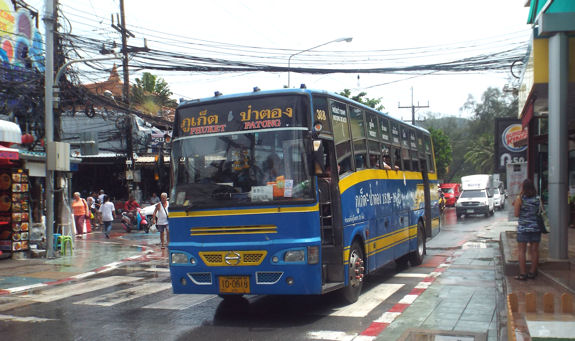
 A second service linking Patong Beach with Phuket Town is provided by air-conditioned minibuses.
 In early 2018, Phuket Smart Bus began operation. This introduced a direct bus link between Phuket's airport to the north of the island and the beach resorts along the west coast.
 High-specification minicoaches operate the Phuket Smart Bus route.


 Taxis are plentiful in Patong Beach. I didn't see any of the three-wheel "tuk-tuks" which can be found on the streets of Bangkok, but I did find plenty of these small four-wheel vehicles touting for business.

 Although many were painted red, I also saw other colours too - pink, yellow, green and blue.


 Unsurprisingly for a major tourist hotspot, private coaches visit Patong Beach.
 Finally, some of the hotels and tourist attractions have their own private transport, as shown by these truck-derived vehicles.