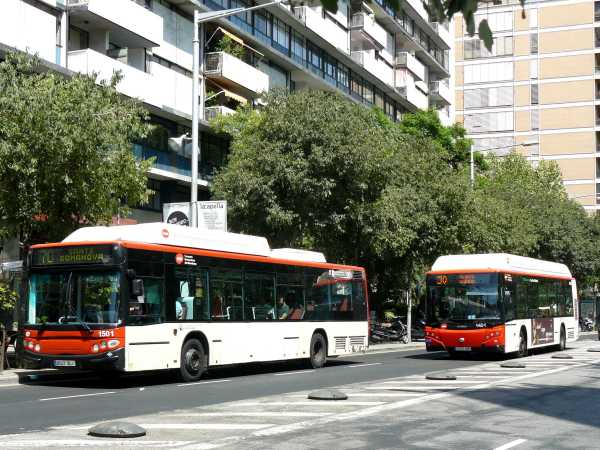
The 1976 Olympic Games were hosted in the city of Montréal. Canada's second largest city with 1.6million inhabitants, Montréal is located in the province of Québec where French is the official language. English is nevertheless widely-spoken.
Montréal had trams in the distant past. The last trams were withdrawn in 1959, in favour of buses. Montréal also had trolleybuses but these, too, had been withdrawn by 1966. In the same year, however, the first sections of Montréal's Metro opened.
 There have been plans to reintroduce trams to Montréal's streets but these are currently unfunded. So, on the city's streets, you will find buses and more buses.
The transport network is provided by STM. The bus fleet comprises low-floor single-deckers, although not all of them are wheelchair-accessible yet. I noted that, as in San Francisco, the front display shows the route number and name (generally the principal road corridor served) rather than an end destination.
 The current livery is white and grey with broad diagonal blue stripes and the large chevrons (the STM logo). There were plenty of buses still carrying an earlier livery with a horizontal blue band (shown below) when I visited in September 2012.
 The bus route numbering follows a system. Routes numbered 10 to 299 are regular services. These are supplemented by a network of express services, numbered in the 400s, which are supported by bus priority measures.
In most cases the Express routes operate only on Mondays to Fridays, and often only in the direction of peak traffic flow.
 Routes numbered in the 700s are shuttle services generally serving tourist destinations and visitor venues. Amongst these are route 715, which serves Montréal's old town (right), while the 747 (below) links the city centre with the airport. The airport has no direct rail link to the city.


The single fare on the STM network is a flat rate regardless of distance travelled. At the time of my visit, this was $3 per trip. Single fare tickets bought using smartcards allowed transfers for up to 2 hours between buses or between bus and metro (provided the journey is in one direction). An out-and back trip isn't covered by a transfer fare, and tickets bought on the bus in cash don't permit transfers. There is also an 24-hour ticket for unlimited travel, priced at $8 at the time I visited.

On the 747 airport shuttle bus, the $3 ticket isn't valid - the 747 only accepts or issues the $8 ticket. When I arrived in Montreal it was evening so, having paid $8 to reach the city centre on the 747, my ticket then enabled me to use the STM network for most of the following day.
Sightseeing tours of Montréal city are operated using two very different - and very interesting - types of vehicle.
 Amphibious vehicles provide a tour which includes both streets and river.
 Alternatively, visitors to Montréal can view the city from the upper-deck of a London bus. A handful of Routemaster buses, retired from many years' service in London, have been shipped to Canada. Their rear staircase and platform have been rebuilt for use in Canada as traffic drives on the right, and they have been converted to open-top.


Although similar to the vehicles used on normal bus services, the single-deck buses in Gray Line colours appear to be for Gray Line's customers, ferrying them to or from the main tours.