Pages

Showing posts with label great britain. Show all posts

Tuesday, 31 December 2019

Saltburn, UK

The small town of Saltburn lies on England's north east coast.  The town developed in the mid-19th Century, both as a seaside resort and also as a centre from which to exploit ironstone which was (and still is) mined nearby.  Today, Saltburn is home to around 6,000 people.

The town itself is perched on cliffs overlooking the beach and the sea.

A funicular railway was built in the 1880s, to improve access between the town and the seafront.  It remains in operation, at weekends from mid-March until October and daily during the peak summer season.

The funicular is powered using water, which is pumped to the upper station then into a tank in the car there, the car then descends by gravity.  The cars are joined by a cable, thus the descending car laden with water pulls the other car up to the top.


More information about the funicular - or the Saltburn Cliff Lift, to give it its proper title, can be found on the Saltburn by the Sea website.

The funicular is not the only railway catering to visitors to Saltburn.  The Saltburn Miniature Railway runs through parkland for about a kilometre from a terminus close to the beach.

The railway operates from around Easter until the end of September.  During school holidays it operates daily except Mondays, otherwise it operates at weekends.

I visited Saltburn out of season, during early March 2019.  Neither the miniature railway nor the funicular were operating when I visited.


Saltburn is served by two regular transport modes, bus and local rail.

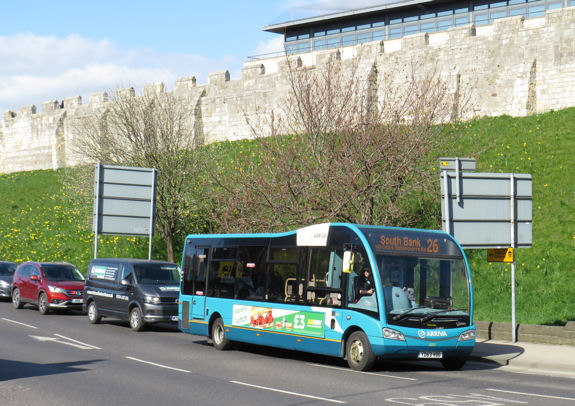
The bus services are provided mainly by Arriva, under their "Sapphire" brand.  Single-deck buses with a single set of doors are operated.

Bus routes X3, X3A and X4 provide a combined 15-minute daytime frequency to Saltburn from Middlesbrough and Redcar.

Routes X3 and X3A each continue hourly beyond Saltburn to nearby Lingdale and Skelton while route X4 operates half-hourly onwards to the town of Whitby, further along the coast.


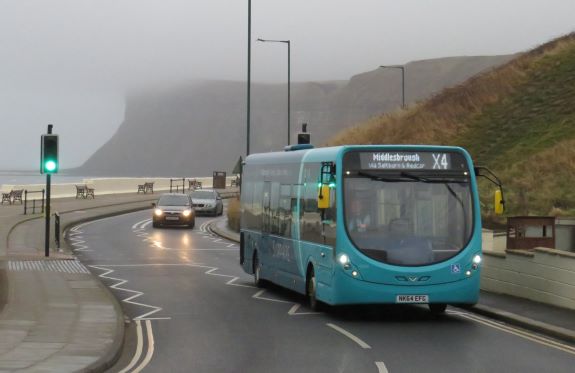


The route taken by the X4 as it enters and leaves Saltburn to and from Whitby uses Saltburn Bank, with a gradient of 1-in-4 (25%) and hairpin bends.


Route X4 is more than 50 kilometres in length.  This would require it to be operated in accordance with EU Drivers' Hours regulations.  These are more stringent than the rules which apply in the UK to scheduled bus routes of less than 50 km.

There is some kind of legal dispensation under which UK bus services can operate under domestic rules, even if they are more than 50 km in length.  They must be advertised as operating in sections (even if the bus and driver both complete a through journey, with nothing more than a change of destination display).  A number of operators take advantage of this dispensation - I have commented on it previously in posts about other places in the United Kingdom.

So, when passing through on their way to Whitby, buses on route X4 display Loftus (for Whitby) as their destination.  On reaching Loftus, the driver will change the display, then continue the journey to Whitby.


A slightly different pattern of services is operated on Sundays.

Route X4 runs hourly rather than half-hourly.  Routes X3 and X3A don't operate, but a service numbered 3 operates in place of the X3.

However, route 3 runs only as far as Redcar, with just the hourly X4 operating to Middlesbrough on Sundays.


"Sapphire" is one of Arriva's premium brands, with buses advertised as providing high-quality seating and free wi-fi.

During the few days I was in and around Saltburn, I noticed several buses which were not to Sapphire specification operating on routes X3, X3A and X4.


At least two were branded for a different route in the Middlesbrough and Redcar area.
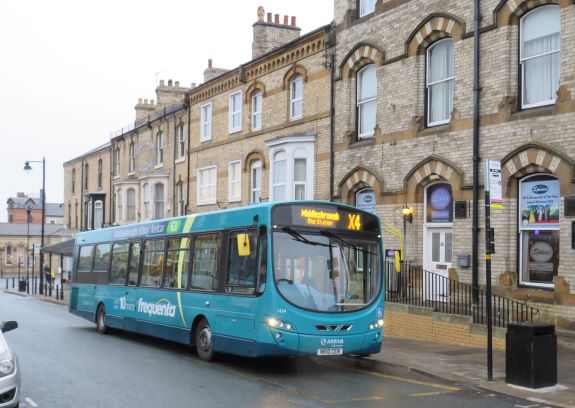


Perhaps it was only to be predicted that while buses branded for route 63 were operating on the X4, at least one of the "Sapphire" buses branded for the X3, X3A and X4 was at work on route 63 in Redcar.


Fares on Arriva's services vary according to distance travelled.  Single and same-day return fares are available.

There is also an array of day tickets allowing unlimited travel, either within a specific area or on Arriva services throughout the north east of England.  In addition, there are day tickets which allow travel on buses operated by other companies, or on certain local rail services.

Arriva's services routes serving Saltburn operate until mid-evening.

During the later evening, Redcar & Cleveland Council provides a minibus service numbered 708 from Saltburn to Lingdale and Loftus.

This service runs six evenings a week.  There is no service on Sundays.


There is one other bus route serving Saltburn.

During the summer months, Moorsbus provides a network of bus routes to enable leisure access by public transport to the North Yorkshire Moors national park.  One Moorsbus journey leaves Saltburn on a Sunday morning, returning in the evening.

The Moorsbus network used to be funded by the North Yorkshire Moors National Park Authority.  However, austerity imposed by the UK government resulted in severe cuts to funding, which meant that the National Park Authority could no longer afford to provide the network.  Moorsbus is now co-ordinated by a team of volunteers relying on donations to keep a reduced network operating.

Finally, Saltburn is the terminus of a local railway line. 

The main station building was sold off some years ago, and has been converted for other commercial uses.  Trains now serve platforms to the side of the building.


Trains generally run half-hourly to Redcar, Middlesbrough and Darlington, where there are main line connections to other parts of the UK.

It may be noted that Arriva's bus services duplicate and compete with the rail service rather than being integrated with it.

This Geograph image copyright to Richard Vince.

Tuesday, 30 April 2019

York, UK

The city of York is one of England's historic cities.  Established in Roman times, the city now has around 150,000 people living within its urban area.  Up to seven million people visit York each year.  I visited in March 2019.

Buses provide York's public transport service.  Buses in Great Britain are deregulated, giving operators freedom to choose which routes to operate for profit.  Local authorities can subsidise services which they deem socially-necessary, but which no operator is willing to operate without subsidy.  There is no single co-ordinated bus network.  Nevertheless the iTravelYork website, provided by the City of York, provides comprehensive and impartial information about all of York's bus services.


Services within the city

Many of the bus services operating locally within York's urban area are operated by First York.


Most of the First York buses I noted were more than 10 years old.

A variety of vehicles is operated.  Double-deck buses are used on a number of services.


Almost all the buses I saw in York had just one entrance/exit door.  This layout is usual in the UK (apart from London), but rare elsewhere in Europe.


The double-deck fleet includes a small number of hybrid-powered vehicles.

These vehicles carry the standard First York colour scheme, and do not proclaim their hybrid credentials.


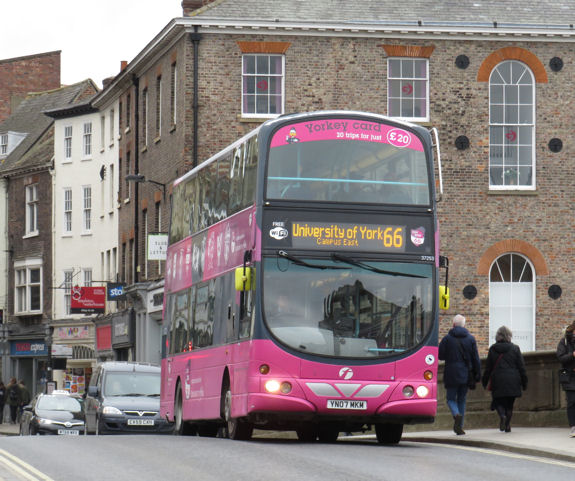
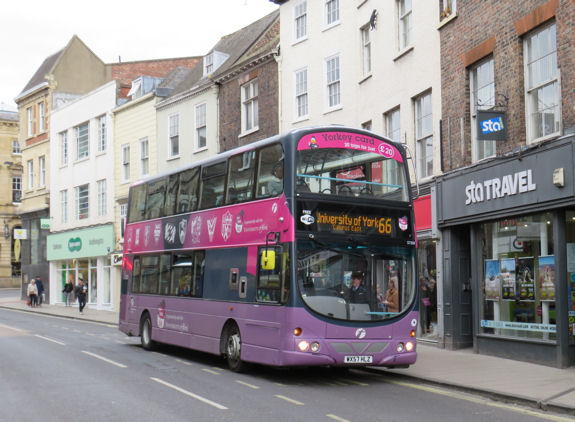
Routes 66 and 66A provide the main link from York city centre and railway station to the university campus.

Buses on routes 66 and 66A carry a dedicated livery with branding specific to these routes.  I saw two versions of the livery.

One was predominately pink...


... while the other was a lilac shade.


One vehicle in pink livery was not carrying specific branding for route 66.

Instead it was advertising that First York now accept payment using contactless bank cards as well as cash on board their buses.


The theory of route branding is fine in my opinion, if the branded buses keep to their intended routes.

In practice, around Britain I often see buses branded for one service operating on another.

York proved no exception to this, with buses branded for routes 66 and 66A operating on other services.


First York's bus fleet also includes a considerable number of single-deck buses.


Route 10 is operated by First York from early morning until mid-evening, seven days a week.  However, First York do not operate route 10 in the late evenings.

A late evening service is provided by another operator, with financial support from City of York Council.


However, the route 10 timetable on First York's website makes no acknowledgement that a late evening service is provided on the route.

A park-and-ride scheme operates in York, with a number of park-and-ride sites located near the city's outer ring road.

Several of First York's bus services operate to the park-and-ride sites.

Buses on these services generally carry a dedicated silver livery.


Operating alongside the standard single-deckers on the park-and-ride-branded services are a number of articulated buses.

In Europe, the articulated buses I have seen have almost all had three, if not four or even five sets of doors.

Those operating in York have just two.


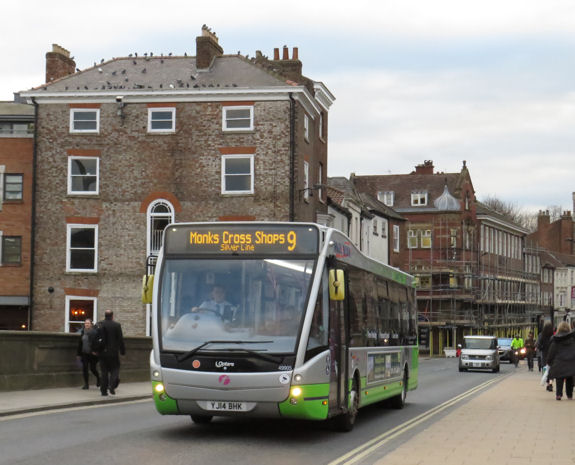
Battery-electric single-deckers are operated on two of the park-and-ride services.  These operate alongside older, diesel-powered buses.

The battery-electric buses have green branding added to their silver livery.


Later in 2019, the battery-electric single-deckers will be joined on the park-and-ride services by a fleet of battery-powered double-deckers.

I did find one double-decker operating on a park-and-ride route.  This vehicle was in standard First York colours rather than park-and-ride livery.

Whether this was a regular scheduled working or an unscheduled substitution, I know not.


Some, but not all, of the park-and-ride services operate as limited stop over part, but generally not all, of their route.

A couple of First York's vehicles wear a yellow livery, promoting the York by bus smartcard.

The smartcard can be loaded with daily, weekly or monthly tickets valid on all bus operators in York.  It cannot be used for "pay as you go" single journeys.


Another bus in special livery was this one, painted in a livery used by First York's predecessor in the 1990s.


Not all local services within York are provided by First York.

Arriva and Connexions Buses each operate three services which are wholly or primarily within the city.

Arriva generally use small single-deck buses on their three services.


I noted one larger bus also operating on one occasion.

I don't know whether this was scheduled, or whether it was merely substituting for one of the smaller vehicles.


Connexions Buses use full-size single-deck buses on route 13.

One of them wears a special livery with branding for the service.


Most of the other buses I saw on route 13 were in Connexions Buses' standard green and white colours.


I did, however, notice one which was in green and silver.  This may be the colour scheme of the bus' previous operator.

The silver should not be confused with the silver livery used by First York on park-and-ride services.


On Connexions' other two York local services, I noted small single-deck buses in use.


Buses from and to the surrounding region

Bus services heading into York from further afield are provided by a variety of operators.


At the time of my visit, Arriva were operating one service into York from the south.  This service uses Sapphire-branded  double-deck buses.


Arriva's Sapphire is a premium brand.  Sapphire-branded services offer free wi-fi and charging points as well as luxury seats and on-board CCTV.

Arriva have since won the contract to operate a second service from Selby, taking over from another operator.

Connexions Buses operate one service into York from the south-west.

Route 412 runs to Wetherby, where buses generally switch to another route taking them onwards to Harrogate.

I noted one vehicle wearing a special dark green livery, branded as Ebor Link.


I also saw buses in Connexions' standard green and white livery in use.


Connexions do not operate all the journeys on route 412.

A couple of isolated journeys are provided by North Yorkshire County Council, using a minibus.

A small card barely visible in the windscreen was the only indication that this vehicle was operating a journey on route 412.


East Yorkshire operate into York from the south east.

Route X46 runs to and from Hull, a lengthy journey taking more than two hours.  Buses on route X46 carry dedicated branding.


The X46 is advertised as running from York to Market Weighton with guaranteed connections (using the same bus) onwards to Hull.  This enables East Yorkshire to treat it as if it were two routes, each of less than 50 kilometres in length.  This in turn results in the route being able to operate under less stringent legal regulations than if it were treated as a single, longer route.

As a result, buses leaving York display Market Weighton, rather than Hull, as their primary destination.


East Yorkshire operate a few other routes into York, using a mix of single-deck and double-deck vehicles.


As with First York, I found one bus wearing a commemorative livery.

This vehicle celebrates the 90th anniversary of East Yorkshire, which was in 2016.

It combines the current livery with two previous liveries worn by the company's buses.


Again, as with First York, I found route-branded buses were not being kept to their intended route.

Although route 46 is a relative of the X46, it is not the same service.


On the same day, an unbranded bus was in use on the X46.


Operating services into York from the north is Reliance, with a fleet mainly comprising single-deck buses.


Transdev operate into York using three distinct brands.

Yorkshire Coastliner is a stand-alone operation, which covers routes 840 and 843.  These are long-distance routes running from the city of Leeds through York to the east coast.

Double-deck buses in a two-tone blue livery operate on Yorkshire Coastliner services.


Route 840, which crosses the North Yorkshire Moors to reach the coastal town of Whitby, was recently voted to be Britain's most scenic bus route in a poll by Bus Users UK.

Some of the buses I saw had signwriting which proclaims this.


Sure enough, I found one of them on the 843.

While that route is itself quite pleasant, it doesn't cover the very scenic road over the moors which won the title for route 840.


Although York and Leeds are connected by a fast and frequent train service, Transdev have introduced non-stop buses branded as CityZap.  These operate non-stop between the two cities, offering faster journey times than the Yorkshire Coastliner 840 and 843.

The CityZap colours are red and silver.


As well as the red and silver buses, I noted one in black and silver colours operating the CityZap service.


More surprisingly, I also noted a single-deck bus on one occasion.

This may have been a short-notice substitution to avoid cancelling a journey, rather than being scheduled.


The blue single-deck bus is branded for York & Country.  This brand is used for other services operated by Transdev in and around York.

York & District buses come in a variety of other colours as well as blue.


I noted several which were red and black.


There was also a bus in black livery, branded as "Little Explorers".

This brand name seems to apply to route 22, which heads into countryside north west of York.  However, I also saw red buses and a blue one on this service.


Meanwhile a bus in white livery was operating on route 42 to Selby.

This route had been taken up by Transdev under a short-term contract when its previous operator ceased trading.

The contract for route 42, which requires subsidy as no operator will run it commercially, has since passed to Arriva.


Another route taken over by Transdev when another operator abruptly ceased trading was the 31X.  The bus I noted on this service was still in the colours of another Transdev fleet operating in north west England.


Transdev has now ceased operating route 31X, with Reliance taking its place.

The other operator providing services into York is York Pullman.

The regular vehicle I saw operating on routes 36 and X36 carried My36 branding.


The bus I saw on route 37 was plain white without any branding.


Route 196 operates one journey a week into York.

The bus I saw on this service was still in the livery of its previous operator.


Route 197 is a special service which operates to and from York's racecourse when there is a race meeting.  Several operators are involved in this service.

This York Pullman double-decker, still carrying the red livery of its previous operator in London, was carrying permanent vinyl displays for route 197.  However, it was operating a school service when I saw it.


Fares and tickets

There is no single co-ordinated fare system for York's buses.  Each operator sets its own fares.

Single fares do not allow interchange between buses.  Some operators offer return tickets, others only offer singles.

A one-day ticket for travel on any bus in York, regardless of operator, is available for £4.90 if bought on the bus.  The York by bus smartcard can be loaded with one-day tickets, which generally works out cheaper, although the minimum number you can buy is two (which can be used on any two days in a 12-month period).

First York do their own day ticket, valid only on their own services, for £4.40.  For travel beyond the York boundary, there is no multi-operator ticket.  Some operators offer their own day ticket, others may not.

Weekly and monthly tickets are similar - an all-operator ticket is available within York but for travel beyond, any ticket will be limited to the services of one operator.


For tourists

Unsurprisingly, for a city which welcomes millions of visitors a year, York has services for tourists.

City Sightseeing provides a hop-on, hop-off tour daily from late February until late October, using open-top double-deck buses. 

The buses I saw had been converted to battery electric power.


The city can also be seen from the river.

Boat tours are also provided by City Cruises.


A themed tour operated in the evenings is the Ghost Bus.

This uses a Routemaster bus which had spent a long working life in London.

Similar tours operate in London and Edinburgh.


Coaches

For a city which receives so many visitors, I did not notice many coaches.  Coaches are not allowed within the city walls, except to use a traffic gyratory system which is straddled by the wall.  There are three designated drop-off and pick-up points near the city centre, and two coach parks.

One of the small number of coaches I did see was this one, operating an excursion to York in conjunction with a cruise ship.


National Express and Megabus both provide scheduled coach services to York from other parts of Britain.


The National Railway Museum

One of York's many visitor attractions is the National Railway Museum.


As well as full-size exhibits, the museum has a model railway.

The model railway isn't the only smaller-scale exhibit.


A miniature railway offers rides in the museum's grounds.


As well as the miniature railway, steam engines operate on a short section of track outside the main exhibition halls.  However, no engines were in steam on the day I visited.

The railway museum is open daily, all year round, except at Christmas.  Admission is free, although there is a charge to ride on the miniature railway or on the steam trains.

A road train provides a link between the museum and York Minster, operating every 30 minutes.

There is a fare of £3 per ride (£2 for children) on the road train.