This scene may appear familiar to followers of "Harry Potter" films.
The Glenfinnan viaduct, in the West Highlands of Scotland, appears in several of the films with the "Hogwarts Express" steam train making its way across on its journey from the mythical Platform 9¾.

 The curved viaduct at Glenfinnan is on the railway line linking Fort William with Mallaig, a distance of 67 kilometres. It ranks amongst the UK's most scenic railway journeys.
"The Jacobite" steam train operates over this route up to twice a day during the summer months.

 The Scottish Highlands are a very popular tourist destination. The Jacobite caters to the tourist market.
Special fares apply on The Jacobite. Regular rail tickets are not valid.
 While steam trains operate seasonally as a tourist attraction, four trains a day operate all year round between Fort William and Mallaig as part of the region's public transport. These are operated by ScotRail.
Three of the four trains continue south of Fort William, to and from Glasgow. During the afternoon, two of the trains are scheduled to pass each other at Glenfinnan.
 I visited Glenfinnan in June 2015, shortly after the franchise to operate ScotRail had passed from First to Abellio.
At the time, most of the trains still carried First corporate colours. However, they are now gaining a ScotRail identity which is not tied to a franchisee.


Glenfinnan station houses a small museum which tells the story of the West Highland Line.
Glenfinnan itself is a very small village, home to around 100 people, making it the smallest place I have yet featured on this blog.
 As well as the train service, Glenfinnan also has a limited bus service, provided by Shiel Buses.
Four journeys a day operate along the main road between Fort William and Mallaig, with one per day linking Fort William with isolated settlements to the south of the main road. I found a coach in use.
The bus timetable is not co-ordinated with that of the parallel train service.
As well as the train service, Glenfinnan also has a limited bus service, provided by Shiel Buses.
Four journeys a day operate along the main road between Fort William and Mallaig, with one per day linking Fort William with isolated settlements to the south of the main road. I found a coach in use.
The bus timetable is not co-ordinated with that of the parallel train service.
 The only other bus I found was this minibus, parked overlooking the main road close to the railway station.

The minibus carries signwriting for the Glenfinnan Station Museum. It looked as though it had not been moved for some time.
 The station museum is not the only visitor attraction at Glenfinnan. This lonely spot was the site of an uprising in 1745.
A monument looks out over Loch Shiel. There is also an exhibition and visitor centre close by.
The station museum is not the only visitor attraction at Glenfinnan. This lonely spot was the site of an uprising in 1745.
A monument looks out over Loch Shiel. There is also an exhibition and visitor centre close by.
Mallaig: End of the line (and the road)
 The road and railway through Glenfinnan both end at the small port of Mallaig. The train journey to here from Glasgow takes more than five hours.
The small steam train, made from wooden barrels, adds to the scene.
The road and railway through Glenfinnan both end at the small port of Mallaig. The train journey to here from Glasgow takes more than five hours.
The small steam train, made from wooden barrels, adds to the scene.
 From Mallaig, ferries sail to the Isle of Skye, and also to the Small Isles (Canna, Eigg, Rum and Muck).
The ferries are currently operated by Caledonian MacBrayne, a company owned by the Scottish government.
From Mallaig, ferries sail to the Isle of Skye, and also to the Small Isles (Canna, Eigg, Rum and Muck).
The ferries are currently operated by Caledonian MacBrayne, a company owned by the Scottish government.
 Sheil Buses operate a local bus service within Mallaig. I found this small single-decker in use. The service runs hourly during the mornings, less frequently during the afternoons.
The timetable is designed to fit around school starting and finishing times. There is no service at weekends.
Sheil Buses operate a local bus service within Mallaig. I found this small single-decker in use. The service runs hourly during the mornings, less frequently during the afternoons.
The timetable is designed to fit around school starting and finishing times. There is no service at weekends.


The only other bus service in Mallaig is Shiel Buses' service to Fort William via Glenfinnan.


The small town of Fort William lies on the Great Glen, a geological fault line which cuts
through the Scottish Highlands. Britian's highest mountain, Ben Nevis, looms over the town. Fort William is also at the northern end of the West Highland Way, a long distance footpath stretching 150 kilometres through remote parts of Scotland. Although Fort William's population numbers only around 10,000, the town is a popular base for walking and other outdoor activities, making it a major tourist centre.
I visited Fort William in June 2015.
No single body has overall responsibility for the transport services in Fort William. However, the Highlands and Islands Transport Partnership (HITRANS) has a strategic responsibility for developing transport across the Scottish Highlands. Meanwhile, the Lochaber Transport Forum has details of all transport services in Fort William.
A small network of local bus services is operated by Stagecoach.
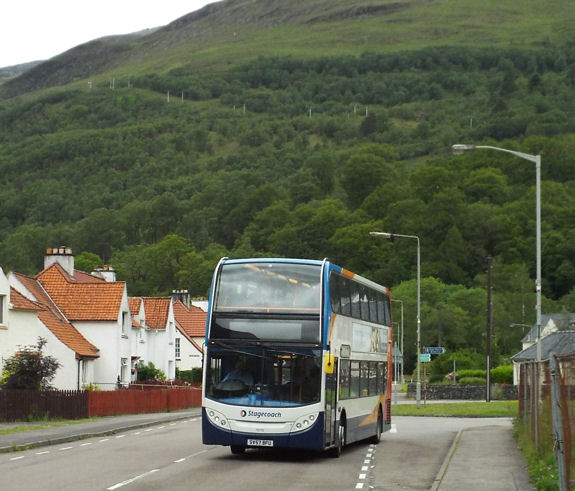
 I was surprised to find that in this relatively small town, most of the buses were double-deck.

 Routes 45, 46 and 47 between them provide the core service across the town.
Each service operates hourly, with a combined service of up to four buses per hour over common sections of route. Evening and Sunday services are more limited.
Some of the double-deckers used in Fort William carry the fort link name.
 Route 41 operates every two hours, reaching a couple of parts of the town which are not served by routes 45, 46 or 47.


 The 41 also heads north-eastwards out of Fort William, to the nearby settlements of Spean Bridge and Roy Bridge.
On the way, it calls in at Nevis Range, a centre for outdoor activities on the slopes of Ben Nevis.

 Route 44 heads in the opposite direction out of Fort William, southwards to the small settlements of Ballachulish and Kinlochleven.
These images were taken in Kinlochleven.

Route 44 generally runs hourly, although a more limited service operates during the evening and on Sundays.
 The reason for using double-deckers in a town as small as Fort William becomes clear at school times. It is at school starting and finishing times that the high capacity of the buses is needed.
At these times, a different pattern of services operates over routes 45, 46 and 47, with buses numbered between 145 and 149.
As well as single and return fares, Stagecoach also offer all-day tickets. These are based on zones. One zone covers Fort William itself and journeys up to around 5 kilometres from the town centre. A two zone ticket is travel from Fort William to points further afield, including Nevis Range, Roy Bridge, Ballachulish and Kinlochleven. Weekly and longer period tickets are also available, based on the same zones.
Publicity for the Stagecoach services states that easy-access, wheelchair-accessible buses are usually operated on these services.
 I was therefore surprised to find that particularly on route 44, several journeys were being operated by high-floor coaches.


 I also found a step-floor single-decker being used on the 44. This bus definitely wasn't wheelchair-accessible.


Since these images were taken, the deadline for all single-deck buses in Britain to comply with accessibility standards has been reached. Single-deckers such as this one can no longer be used on regular bus services.
 It wasn't just the 44 where vehicles other than low-floor were being used.
I found a coach in Scottish Citylink livery being used on a journey on route 41.
Not all bus services in Fort William are provided by Stagecoach.
 Shiel Buses operates several services into Fort William from the sparsely-populated area to the west.
These services are infrequent, with none operating more than three or four journeys per day.
A mix of coaches and minibuses were being used on these services.


 Scottish Citylink provides a network of longer-distance coach services across Scotland. Several Citylink routes serve Fort William.
The coach stops are alongside Fort William railway station.
Routes 914, 915 and 916 pass through Fort William on their way from Glasgow and Loch Lomond to the Isle of Skye.
Scottish Citylink provides a network of longer-distance coach services across Scotland. Several Citylink routes serve Fort William.
The coach stops are alongside Fort William railway station.
Routes 914, 915 and 916 pass through Fort William on their way from Glasgow and Loch Lomond to the Isle of Skye.
 The Citylink livery is yelow and blue. However, I noted several coaches in the colours of their individual operating companies, but with Citylink yellow at the rear.


 On route 918, linking Fort William with Oban, I noted coaches without any Citylink branding.

 Citylink 919 operates along the Great Glen, linking
Fort William with Loch Ness and Inverness. During the early mornings and evenings, when route 919 doesn't operate, Stagecoach operate a few journeys as route 19.
Citylink 919 operates along the Great Glen, linking
Fort William with Loch Ness and Inverness. During the early mornings and evenings, when route 919 doesn't operate, Stagecoach operate a few journeys as route 19.
Routes 919 and 19 have been featured on the Great British Bus Routes blog.
Although return tickets are interchangeable between the 919 and 19, the two services may charge different fares.
 Just as I found a Scottish Citylink coach being used on a local bus service in Fort William, I found Stagecoach single-deck buses operating on Scotish Citylink route 919.
The lack of luggage space on these buses makes tham less than ideal for use on the 919, which provides a strategic link across the Scottish Highlands.
 Fort William is also served by rail.
The West Highland Line is one of Britain's most scenic railway routes. A daytime service of 3-4 trains per day is operated by ScotRail, running from Glasgow to Fort William then on to Glenfinnan and Mallaig.
Fort William is also served by rail.
The West Highland Line is one of Britain's most scenic railway routes. A daytime service of 3-4 trains per day is operated by ScotRail, running from Glasgow to Fort William then on to Glenfinnan and Mallaig.
 An overnight train service linking Fort William with London is operated by Caledonian Sleeper, six nights a week.

 During the summer season, "The Jacobite" steam trains operate from Fort William to the end of the line at Mallaig.
Special fares apply on these trains, ScotRail tickets aren't valid on them.
During the summer season, "The Jacobite" steam trains operate from Fort William to the end of the line at Mallaig.
Special fares apply on these trains, ScotRail tickets aren't valid on them.
 A ferry service crosses the loch from Fort William to Camusnagaul, 4-5 times a day. Details are on the Lochaber Transport Forum website.
Camusnagaul is also linked to Fort William by one of Shiel Buses' services. The bus journey takes around 50 minutes, around the head of the loch. The ferry takes 10 minutes.
A ferry service crosses the loch from Fort William to Camusnagaul, 4-5 times a day. Details are on the Lochaber Transport Forum website.
Camusnagaul is also linked to Fort William by one of Shiel Buses' services. The bus journey takes around 50 minutes, around the head of the loch. The ferry takes 10 minutes.
 The ferry operates from a small jetty in Fort William.

 In the centre of Fort William, outside one of the town's shops selling outdoor goods, is a cable car. Just one, a static cabin with nowhere to go.

 Travel out to the Nevis Range centre, however, and you will find a cable car system climbing from there up the mountainside.
The cable cars were installed to carry skiers and their equipment to slopes on the mountainside.
Travel out to the Nevis Range centre, however, and you will find a cable car system climbing from there up the mountainside.
The cable cars were installed to carry skiers and their equipment to slopes on the mountainside.


 The cable cars carry bicycles, which can be attached to racks on the outside of the cabin. Mountain biking is a popular activity in this area.
Other than an annual closure for maintenance in November/December, the cable car operates all year round. However, it may close temporarily during high winds.
The cable cars carry bicycles, which can be attached to racks on the outside of the cabin. Mountain biking is a popular activity in this area.
Other than an annual closure for maintenance in November/December, the cable car operates all year round. However, it may close temporarily during high winds.

 This scene may appear familiar to followers of "Harry Potter" films.
 The curved viaduct at Glenfinnan is on the railway line linking Fort William with Mallaig, a distance of 67 kilometres. It ranks amongst the UK's most scenic railway journeys.
 The Scottish Highlands are a very popular tourist destination. The Jacobite caters to the tourist market.
 While steam trains operate seasonally as a tourist attraction, four trains a day operate all year round between Fort William and Mallaig as part of the region's public transport. These are operated by ScotRail.
 I visited Glenfinnan in June 2015, shortly after the franchise to operate ScotRail had passed from First to Abellio.

 As well as the train service, Glenfinnan also has a limited bus service, provided by Shiel Buses.
 The only other bus I found was this minibus, parked overlooking the main road close to the railway station.
 The station museum is not the only visitor attraction at Glenfinnan. This lonely spot was the site of an uprising in 1745.
 The road and railway through Glenfinnan both end at the small port of Mallaig. The train journey to here from Glasgow takes more than five hours.
 From Mallaig, ferries sail to the Isle of Skye, and also to the Small Isles (Canna, Eigg, Rum and Muck).

 Sheil Buses operate a local bus service within Mallaig. I found this small single-decker in use. The service runs hourly during the mornings, less frequently during the afternoons.