New York lies on a natural harbour. This enabled the city to thrive as a major port on America's Atlantic coast, facilitating trade with other nations. This brought prosperity to New York driving its growth to become one of the world's major financial, economic and cultural hubs.
New York today has the highest population of any American city, with more than 8 million inhabitants spread across five boroughs - Brooklyn, the Bronx, Manhattan, Queens and Staten Island. Manhattan is at the heart of the New York.
 Think of street transport in London and its iconic red buses will doubtlessly come to mind. Think of street transport in New York and your first thought may well be of bright yellow taxis. You will find plenty of them on the streets and avenues of Manhattan.
You won't find trams (or streetcars, as the Americans call them) in Manhattan. The last ones were replaced by buses as long ago as 1947, although they clung on in Brooklyn until 1956. New York does, however, have an extensive network of bus routes.
The main transport system
Most of New York's buses are operated by subsidiaries of the New York Metropolitan Transit Authority (MTA), which co-ordinates city's public transport system.
Think of street transport in London and its iconic red buses will doubtlessly come to mind. Think of street transport in New York and your first thought may well be of bright yellow taxis. You will find plenty of them on the streets and avenues of Manhattan.
You won't find trams (or streetcars, as the Americans call them) in Manhattan. The last ones were replaced by buses as long ago as 1947, although they clung on in Brooklyn until 1956. New York does, however, have an extensive network of bus routes.
The main transport system
Most of New York's buses are operated by subsidiaries of the New York Metropolitan Transit Authority (MTA), which co-ordinates city's public transport system.
 Many of the buses operating in central Manhattan are conventional single-deckers. All are wheelchair-accessible, either with ramps or lifts. Route numbers are prefixed according to the borough in which they operate, with the letter M for those which operate primarily in Manhattan.

 There has been considerable investment in clean technology in recent years. Of a fleet of around 6,000 buses acros New York, over 2,000 are powered either by compressed natural gas or diesel-electric hybrid power. By 2015, MTA aims to have 80% of the bus fleet running on clean technology. I didn't notice any CNG-powered buses in central Manhattan (at least, none which were obvious to me), but there were plenty of hybrids at work.


 Some routes operate as limited-stop services at certain times of day. Generally this applies during the daytimes with buses serving all stops in the evenings and weekends.
 As well as the standard single-deckers, there are a number of articulated buses. The older vehicles have two doors, the newer ones have three.
 Services operating east-west across midtown and uptown Manhattan are generally numbered to match the street they serve. Thus the M14A and M14D operate along 14th Street, the M23 on 23rd Street and so on. There are exceptions to the rule, however, and no such principle applies to routes running north-south on the Avenues.

 Routes M34/M34A, operating on 34th Street, and part of the service on route M15 on 1st/2nd Avenues, have been upgraded to bus rapid transit standards to provide faster, more reliable journeys. These services are branded as "+Select Bus Service". +Select bus services are limited stop. The buses carry a distinctive livery - and at the time of my visit, blue flashing lights either side the destination display. The use of blue lights has since been discontinued, allegedly because they did not comply with state traffic laws.

 On +Select Bus Services, cash fares
are not collected on the bus. Instead any cash fares must be paid into a
roadside ticket machine. Boarding is through any door, with inspectors doing random checks to ensure passengers have a valid ticket or receipt for travel.
On +Select Bus Services, cash fares
are not collected on the bus. Instead any cash fares must be paid into a
roadside ticket machine. Boarding is through any door, with inspectors doing random checks to ensure passengers have a valid ticket or receipt for travel.
 Not all buses on route M15 are part of +Select Bus Service. A conventional stopping service operates along the same route, using the same number.
 Express
services operate into Manhattan from Staten Island, Queens, Brooklyn and
the Bronx. A few of these operate daily, all day, but most operate
only at peak times. Premium fares are charged on these services. Three-axle high-floor coaches are used. These are fitted with a
wheelchair lift at the centre door.
Express
services operate into Manhattan from Staten Island, Queens, Brooklyn and
the Bronx. A few of these operate daily, all day, but most operate
only at peak times. Premium fares are charged on these services. Three-axle high-floor coaches are used. These are fitted with a
wheelchair lift at the centre door.


 Some of the Express routes, including all the routes to and from Staten Island,
are numbered with an "X" prefix. Other Express routes are numbered
with a two or three letter prefix denoting the boroughs they serve.
Thus routes with a "QM" number link Queens with Manhattan, "BxM" means
Bronx-Manhattan, "BM" indicates Brooklyn-Manhattan.
Some of the Express routes, including all the routes to and from Staten Island,
are numbered with an "X" prefix. Other Express routes are numbered
with a two or three letter prefix denoting the boroughs they serve.
Thus routes with a "QM" number link Queens with Manhattan, "BxM" means
Bronx-Manhattan, "BM" indicates Brooklyn-Manhattan.


Two of the Express routes from Staten island are operated by Atlantic Express under contract to MTA, rather than directly by an MTA subsidiary.
 Staten
Island lies across Upper New York Bay from Manhattan. There are no
rail or subway links between the two. Express buses operate from
Manhattan using tunnels to reach either New Jersey or Brooklyn then
bridges to reach Staten Island. Otherwise the link from Manhattan is
provided by Staten Island Ferry, which operates free of charge. The ferry passes close to the Statue of Liberty.
Staten
Island lies across Upper New York Bay from Manhattan. There are no
rail or subway links between the two. Express buses operate from
Manhattan using tunnels to reach either New Jersey or Brooklyn then
bridges to reach Staten Island. Otherwise the link from Manhattan is
provided by Staten Island Ferry, which operates free of charge. The ferry passes close to the Statue of Liberty.
The New York Subway is doubtlessly more well-known than the city's buses. Although the system runs beneath the streets in most of Manhattan, around 40% of the total subway system is above ground. This image was taken in Brooklyn:
 A simple fare system applies across the MTA bus and Subway systems. At the time of writing, a single journey costs $2.50 on the Subway and on local, limited stop and +Select buses, or $6 on Express buses. The fare allows one transfer between buses, or between bus and Subway, within 2 hours. Fares can be paid using the MetroCard, a stored-value ticket, or by cash (except on +Select bus services). When fares are paid in cash on the bus, they must be paid using coins to make the exact fare. No change is given and dollar bills are not accepted.
As well as the Subway, MTA operates three suburban railway systems. The Staten Island Railroad is a self-contained system on Staten Island, and fares (including transfers) are the same as on the Subway. The other two systems, Metro-North and the Long Island Railroad, both extend well beyond the New York City boundary. Different fares apply and these do not include transfer to/from buses or the Subway, not even for journeys entirely within New York City boundaries.
Other transport providers
A simple fare system applies across the MTA bus and Subway systems. At the time of writing, a single journey costs $2.50 on the Subway and on local, limited stop and +Select buses, or $6 on Express buses. The fare allows one transfer between buses, or between bus and Subway, within 2 hours. Fares can be paid using the MetroCard, a stored-value ticket, or by cash (except on +Select bus services). When fares are paid in cash on the bus, they must be paid using coins to make the exact fare. No change is given and dollar bills are not accepted.
As well as the Subway, MTA operates three suburban railway systems. The Staten Island Railroad is a self-contained system on Staten Island, and fares (including transfers) are the same as on the Subway. The other two systems, Metro-North and the Long Island Railroad, both extend well beyond the New York City boundary. Different fares apply and these do not include transfer to/from buses or the Subway, not even for journeys entirely within New York City boundaries.
Other transport providers
 Not all buses on Manhattan's streets are part of MTA's network.
Downtown Connection provides a free service sponsored by the Alliance for Downtown New York and the Battery Park City Authority, linking various business sites in Lower Manhattan. Minibuses-style vehicles are used - but I would deem these minibuses to be supersize!
Not all buses on Manhattan's streets are part of MTA's network.
Downtown Connection provides a free service sponsored by the Alliance for Downtown New York and the Battery Park City Authority, linking various business sites in Lower Manhattan. Minibuses-style vehicles are used - but I would deem these minibuses to be supersize!
 NYWaterway operates ferries on the Hudson River. A free bus service provides connections into midtown Manhattan.
 The NYU Langone Medical Center operates its own inter-site bus services. At peak times, a service operates into downtown Manhattan.
At first glance, this vehicle may look quite British. It was in fact built by Blue Bird, a North American manufacturer which was at one point in common ownership with a British bus manufacturer.
Seeing the sights
The NYU Langone Medical Center operates its own inter-site bus services. At peak times, a service operates into downtown Manhattan.
At first glance, this vehicle may look quite British. It was in fact built by Blue Bird, a North American manufacturer which was at one point in common ownership with a British bus manufacturer.
Seeing the sights
 New York attracts many millions of visitors every year. Several companies offer open-top bus tours, including Gray Line, City Sightseeing, City Sights NY and Big Taxi Tours.


Airport transfers
Three
main airports serve New York. Although all three can be reached by a
combination of either subway or suburban rail then local bus or airport
shuttle train, direct buses also link them with Manhattan.
 NYCAirporter
operates to JFK and LaGuardia aiports, both of which are in Queens.
Supersize minibuses are used. These have a luggage compartment at the
rear.
NYCAirporter
operates to JFK and LaGuardia aiports, both of which are in Queens.
Supersize minibuses are used. These have a luggage compartment at the
rear.
 Newark International Airport, in the state of New Jersey, is served by Newark Aiport Express. Full-size coaches are operated.
And finally...
Manhattan also has a cable car, although this is referred to as a tramway. It provides a link over the East River to Roosevelt Island. It is not part of the MTA system, but charges the same fares and accepts MetroCards.
Newark International Airport, in the state of New Jersey, is served by Newark Aiport Express. Full-size coaches are operated.
And finally...
Manhattan also has a cable car, although this is referred to as a tramway. It provides a link over the East River to Roosevelt Island. It is not part of the MTA system, but charges the same fares and accepts MetroCards.
The city of San Francisco, on America's west coast, is one of the world's major tourist destinations. Its claims to fame include the Golden Gate Bridge, the former prison island of Alcatraz (in the background of this image), and its cable cars.
San Francisco Municipal Transportation Agency (SFMTA) has overall responsibility for all forms of transport within the city, while the public transport system is operated by
San Francisco Municipal Railway (Muni).
Although San Francisco's cable cars have become a world-famous tourist attraction, the
network was threatened with closure in the 1950s and some sections did close. A public campaign ensured the survival of the remaining system, which has
been designated as a national historic monument.
Three routes operate.
The Powell-Mason and
Powell-Hyde routes both run north from the city centre along part of Powell
Street, then serve parts of Mason and Hyde Streets respectively. As can be seen from some of these images, they encounter steep gradients.


 The cable cars on the Powell-Mason and Powell-Hyde routes can only be operated in one direction, therefore a turntable is used at the terminus to enable them to change direction.
The California route
operates on an east-west axis on California Street. Longer,
double-ended cars are used on this route, therefore no turntable is
needed at the termini. This route also encounters steep gradients.

 The cable cars are so named because they are powered by gripping a cable running beneath the road surface at a steady speed. The cable is in continuous motion, the grip operator therefore releases the grip to disengage power. The engine room is also a cable car museum, open 7 days a week with free admission.
This image was taken in the museum, overlooking the engine room, and shows the four cables which between them haul all the cars on the system.
 Cable cars heading into the city centre pass the cable car museum, on the corner of Mason Street and Washington Street.
The cable cars
operating now are clearly primarily a tourist attraction. When I visited San Francisco in September 2012, the cable car fare for a single ride was
$6 per journey, with no transfers permitted, compared to $2 (with transfers) on
other modes of transport within San Francisco. The
cable cars are very popular, and long queues can form through much of
the day. One way to avoid the queues is to ride early in the day.
The other transport modes are mix of buses, trolleybuses and trams (or streetcars, as they are generally called in the USA). These, too, provide plenty of interest as well as variety.
 The main route for streetcars used to be Market Street, which runs south-westwards from the city centre. During the early 1980s, the streetcars were diverted into a tunnel beneath Market Street. The tracks at street level were retained, initially for seasonal streetcar festivals, while plans for a historic streetcar service were developed. The historic streetcar service, the "F" line, was introduced in 1995.
 Many of the streetcars date from the 1940s. These cars carry a variety of liveries from different US and Canadian cities. However, most of the cars actually came from one city, Philadelphia.

 The former Philadelphia cars are uni-directional with doors on one side only. There are also three bi-directional cars with doors on both sides. These were new to Muni, although two of them carry liveries from other cities (Philadelphia and St. Louis)

Initially, the "F" line ran along Market Street, from Castro to the city centre. In 2000, it was extended to the Fisherman's Wharf area, popular with tourists.

 The extension to Fisherman's Wharf meant extra vehicles were needed. These were acquired from the Italian city of Milan. Those which I saw retain the orange livery they carried in Italy, and even some signwriting in Italian!


Although the former Milan cars date from 1928, they aren't the oldest streetcars on San Francisco's streets. This car, delivered new to Muni, was built in 1914.

The historic streetcars were not built with present-day accessibility in mind. Nevertheless they are able to carry passengers using wheelchairs. The cars carry portable ramps which can be placed over the steps at the front entrance door to a raised platform at designated stops.
There is a streetcar museum and gift shop near the Ferry Building in the centre of San Francisco.
More information about the historic streetcars, and the cable cars, can be found on the
Market Street Railway website.
Unlike
the cable cars, normal fares apply on the "F" line. Single journey
tickets are valid for up to 90 minutes for transfer to, from and between
other Muni services.
Modern streetcars operate on six other lines (J, K, L, M, N and T), known as "Muni Metro". All six lines use the tunnel beneath Market Street. Elsewhere, many parts of the network are above ground.
The articulated vehicles may operate as single units...

...or coupled together in pairs.


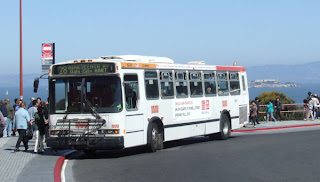 San Francisco's bus network is operated with single-deck vehicles. As well as a number, each route is named, generally after one of the main streets which the route follows. The route name is displayed in capitals above the destination.
Route 28 serves the Golden Gate Bridge visitor centre. Alcatraz island is in the background.
 The destination display may also show other messages, such as in support of San Francisco's football team, alternating with the route display.
Buses can carry 2 bicycles in a rack attached to the front of the vehicle.
 While some buses carry a white livery, others are in this red and silver scheme.
As well as standard single-deckers, articulated buses are also operated.


 America has long been home to yellow school buses. These can be seen in San Francisco's suburbs.

 Hybrid vehicles were introduced to San Francisco's streets from 2007.

 Some of the hybrids are shorter-length, such as these which I found operating on a local route a short distance away from the city centre.

A longer-established form of "clean" technology is the trolleybus. San Francisco's fleet carries both white and red/silver liveries.


 Articulated trolleybuses are also operated.
Muni is considering bringing further trolleybuses, including more articulated vehicles, into the fleet to enable more routes to be converted from diesel-powered buses.
Articulated trolleybuses are also operated.
Muni is considering bringing further trolleybuses, including more articulated vehicles, into the fleet to enable more routes to be converted from diesel-powered buses.
Unsurprisingly for such a major tourist destination, sightseeing tour buses are plentiful in San Francisco. Some are purpose-built open-toppers.


 There are some built to resemble cable cars.
 Some of the sightseeing buses are British double-deckers converted to open-top and exported thousands of miles from their original home.


A few of the open-toppers are even more well-travelled. The British registration plate carried by this vehicle is a clue that it had previously been used in London (also on sightseeing tours) but it originally operated in Hong Kong.
 Not all
of the sightseeing buses are double-deck. I noticed at least one
single-decker, converted to part open-top, operating on San Francisco
sightseeing tours.
Not all
of the sightseeing buses are double-deck. I noticed at least one
single-decker, converted to part open-top, operating on San Francisco
sightseeing tours.
 The island of Alcatraz is reached by ferry. Boats leave regularly from the Fisherman's Wharf area. It's a popular attraction, and worth booking the boat in advance to avoid queueing.
 It is here on Alcatraz that you will find a form of transport calling itself a tram (rather than a streetcar, cable car or Muni Metro). This "tram" is a road train, which assists people with impaired mobility to explore the island.
 Think of street transport in London and its iconic red buses will doubtlessly come to mind. Think of street transport in New York and your first thought may well be of bright yellow taxis. You will find plenty of them on the streets and avenues of Manhattan.
 Many of the buses operating in central Manhattan are conventional single-deckers. All are wheelchair-accessible, either with ramps or lifts. Route numbers are prefixed according to the borough in which they operate, with the letter M for those which operate primarily in Manhattan.


 As well as the standard single-deckers, there are a number of articulated buses. The older vehicles have two doors, the newer ones have three.
 Services operating east-west across midtown and uptown Manhattan are generally numbered to match the street they serve. Thus the M14A and M14D operate along 14th Street, the M23 on 23rd Street and so on. There are exceptions to the rule, however, and no such principle applies to routes running north-south on the Avenues.
 Routes M34/M34A, operating on 34th Street, and part of the service on route M15 on 1st/2nd Avenues, have been upgraded to bus rapid transit standards to provide faster, more reliable journeys. These services are branded as "+Select Bus Service". +Select bus services are limited stop. The buses carry a distinctive livery - and at the time of my visit, blue flashing lights either side the destination display. The use of blue lights has since been discontinued, allegedly because they did not comply with state traffic laws.
 Not all buses on route M15 are part of +Select Bus Service. A conventional stopping service operates along the same route, using the same number.
 Express
services operate into Manhattan from Staten Island, Queens, Brooklyn and
the Bronx. A few of these operate daily, all day, but most operate
only at peak times. Premium fares are charged on these services. Three-axle high-floor coaches are used. These are fitted with a
wheelchair lift at the centre door.
Express
services operate into Manhattan from Staten Island, Queens, Brooklyn and
the Bronx. A few of these operate daily, all day, but most operate
only at peak times. Premium fares are charged on these services. Three-axle high-floor coaches are used. These are fitted with a
wheelchair lift at the centre door. 


 Staten
Island lies across Upper New York Bay from Manhattan. There are no
rail or subway links between the two. Express buses operate from
Manhattan using tunnels to reach either New Jersey or Brooklyn then
bridges to reach Staten Island. Otherwise the link from Manhattan is
provided by Staten Island Ferry, which operates free of charge. The ferry passes close to the Statue of Liberty.
Staten
Island lies across Upper New York Bay from Manhattan. There are no
rail or subway links between the two. Express buses operate from
Manhattan using tunnels to reach either New Jersey or Brooklyn then
bridges to reach Staten Island. Otherwise the link from Manhattan is
provided by Staten Island Ferry, which operates free of charge. The ferry passes close to the Statue of Liberty.
 Not all buses on Manhattan's streets are part of MTA's network.
 NYWaterway operates ferries on the Hudson River. A free bus service provides connections into midtown Manhattan.
 New York attracts many millions of visitors every year. Several companies offer open-top bus tours, including Gray Line, City Sightseeing, City Sights NY and Big Taxi Tours.


 NYCAirporter
operates to JFK and LaGuardia aiports, both of which are in Queens.
Supersize minibuses are used. These have a luggage compartment at the
rear.
NYCAirporter
operates to JFK and LaGuardia aiports, both of which are in Queens.
Supersize minibuses are used. These have a luggage compartment at the
rear. Newark International Airport, in the state of New Jersey, is served by Newark Aiport Express. Full-size coaches are operated.


