As with all settlements on the Belgian coast, Blankenberge is on the route of the Belgian coastal tram.

 Running from Knokke-Heist near the Dutch border, through Blankenberge and Oostende to De Panne close to the border with France, linking all the communities along the Belgian coast, the coastal tram route stretches for nearly 70 kilometres. This makes it the longest tram line in the world.
The tram is the principal local transport service in and through Blankenberge.
 The tram is operated by DeLijn, who provide local bus and tram services throughout Belgium's Flanders region.
De Lijn's fleet livery is white, grey and black with a yellow flash. However, a number of the trams carry advertising liveries.

The tram generally operates every 15 minutes, 7 days a week. From October to March, the frequency drops to every 20 minutes on Mondays to Fridays, although a 15-minute frequency is maintained at weekends. Trams are less frequent during the early morning and evening.
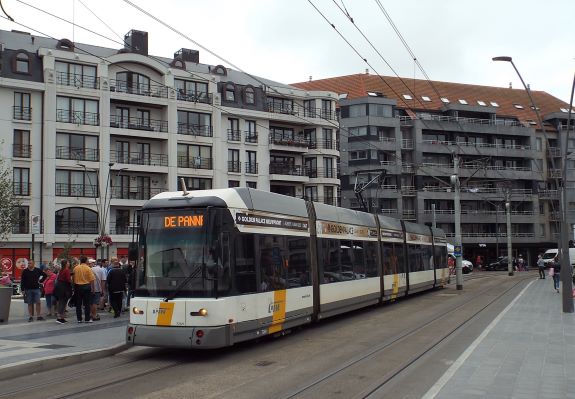 During the high summer months, however, the Belgian coast is busy with holidaymakers, and the tram frequency is increased to every 10 minutes.
Extra trams are loaned from the system in Gent for July and August to enable this enhanced service to operate.


The tram is complemented by a couple of bus services.
Bus route 33 links Blankenberge with the nearby city of Brugge, also known as Bruges. Buses generally run at an hourly frequency, seven days a week.
I found articulated buses and standard single-deckers in use on route 33.


Route 38 is a local service operating within Blankenberge, under the brand name "Centrumbus". I found a minibus in use on this service.
Like route 33, route 38 operates to an hourly frequency, seven days a week, but there is no evening service.


There is one further bus service. Route 36 is a demand-responsive service operating from Blankenberge into the sparsely-populated area inland. DeLijn's demand-responsive services are branded as 'Belbus'.
A simple fare system applies on the DeLijn network, including Belbus services. At the time of writing a single ticket costs €3, regardless of distance travelled, and includes interchanges for up to 60 minutes after first boarding. 10-journey tickets are available for €16, offering a considerable saving over individual single tickets. A one-day ticket giving unlimited travel on almost all DeLijn services is available for €7, there is also a three-day ticket costing €14.
Single journey tickets and 1- and 3- day tickets can be bought from bus drivers. They are also sold by tram drivers, at stops which do not have a ticket machine or a ticket vending kiosk. Ticket vending kiosks and ticket machines at tram stops also sell the 10-journey ticket, these cannot be bought on board a bus or tram. Belgian railway stations and a network of ticket agents also sell the 10-journey ticket and the 1- and 3-day tickets.
Tickets can also be bought by SMS text message for immediate use, or on a mobile app for immediate or later use. Tickets bought by SMS or mobile app are considerably cheaper than traditional tickets.
Within the West Flanders province, there is also a 7-day pass valid on all DeLijn services within the province. West Flanders covers the entire Belgian coastline, and also includes Brugge and Ieper (Ypres). The 7-day pass costs €26 for one person or €40 for two people travelling together. Unlike the 1- and 3-day tickets, the 7-day pass is restricted to West Flanders and cannot be used on services in other provinces. The 7-day ticket is sold by ticket machines and ticket vending kiosks.
 Finally, DeLijn is not the only transport provider in Blankenberge.
The town has a railway terminus, with hourly trains to Brugge, Gent, Brussels and beyond. These are provided by Belgian national rail operator NMBS/SNCB.
The rail system has its own fare and ticketing system, which is separate from the DeLijn system. DeLijn tickets cannot be used on NMBS/SNCB train services.
Images in this post were taken during August 2018.